
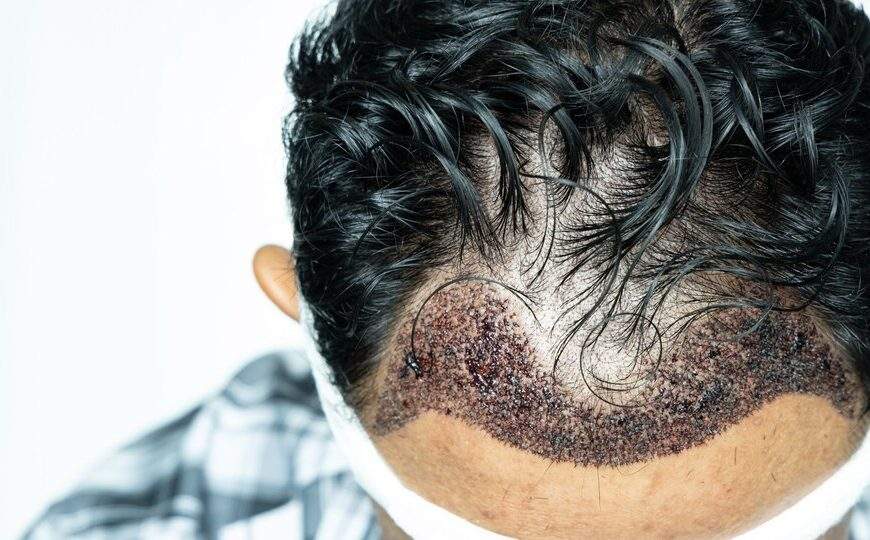
Most patients walk into a consultation asking one question: how many grafts can I get?
It is the wrong question. The better one is: how many grafts do I have — for the rest of my life?
Your donor area, the horseshoe band of hair at the back and sides of your scalp, is not a renewable field. It is a fixed reserve of genetically permanent follicles. Every graft removed is removed forever. Spend it well and you have coverage for the next thirty years. Spend it badly and you are left with a thin, scarred, patchy donor zone and no way to repair the damage — because the material needed to repair it is exactly what was wasted.
This is the single most under-discussed subject in hair restoration in India, and it is the one that separates a result you are happy with at 55 from one you regret at 40.
What “Safe Donor Area” Actually Means
The permanent zone is defined by biology, not by how much hair you currently have. Follicles in the occipital and lateral scalp are largely resistant to DHT, the hormone that miniaturises hair in androgenetic alopecia. Follicles just outside that zone are not — they only look permanent today.
This is why age matters so much. As the American Hair Loss Association and multiple donor-management reviews emphasise, what appears to be safe donor territory in a 22-year-old may be actively balding territory by 35. Harvest from that intermediate margin and you have transplanted hair that will fall out on schedule, while permanently thinning the donor site you took it from. You lose twice.
A surgeon planning properly maps the true safe zone against your family history, your current miniaturisation pattern, and the loss you have not had yet. A clinic optimising for graft count on an invoice does not.
Overharvesting: The Damage That Cannot Be Undone
Overharvesting means extracting too many follicular units, too densely, from too small an area. The consequences are well documented in the donor-management literature: permanently reduced donor density, visible see-through thinning when hair is worn short, and a moth-eaten appearance where remaining follicles sit separated by punch scar tissue.
The most damaging part is what it forecloses. A patient with an intact donor area and a mediocre first result has options. A patient with a depleted donor area does not — there is nothing left to move.
The scale of this problem is growing. Repair cases arising from unregulated, high-volume “black-market” procedures rose to roughly 10% of all repair cases reported by ISHRS members in 2024, up from 6% in 2021, with overharvesting a leading complication. Much of that volume is driven by clinics competing on graft count and price.
Responsible practice works the other way around. FUE sessions are typically capped near 2,500–3,000 grafts to stay inside safe extraction density, and extractions are mapped zone by zone so removal is distributed evenly rather than concentrated in one patch. Cumulative extraction across sessions has to be tracked over years, not per procedure.
Transection: The Loss You Never See
Even when graft numbers are conservative, grafts can be destroyed during removal. Transection is the cutting or damaging of a follicle as the punch passes into the scalp. A transected graft may not grow at all — and the follicle it came from is gone from the donor area regardless.
Published figures put an acceptable transection rate at around 5%, with experienced surgeons routinely achieving 3–5%. The more revealing metric is hidden transection, damage occurring below the skin surface that is invisible on inspection. One comparative study found expert and beginner operators produced similar visible transection rates, but hidden transection diverged sharply: approximately 2% for the expert versus 8% for the beginner.
Read that again. On identical-looking work, four times the hidden damage. The patient cannot see the difference on the day of surgery. They see it eighteen months later, in density that never quite arrived.
Fatigue compounds it. Extraction quality degrades over long sessions, which is why researchers have flagged surgeon workload — particularly beyond 2,500 units — as a factor routinely omitted from transection studies.
Why Who Holds the Punch Is Not a Detail
At many high-volume clinics, the surgeon designs the hairline, greets the patient, and then leaves. Extraction — the step that determines transection rate, follicle selection and donor-area preservation — is delegated to technicians, sometimes several working in parallel to move through more cases per day.
At Monaris Hair Clinic, that does not happen. Dr. Arihant Surana performs every procedure personally, including 100% of follicle extraction. No junior doctor, no technician, no parallel team.
Three things follow from that, and all three are about your donor area:
- Transection stays low. Consistent technique from a single experienced operator keeps damage near the expert end of the published range rather than the beginner end.
- Follicle selection is correct. Distinguishing permanent follicles from temporary ones at the margin is a clinical judgement, not a mechanical task. It cannot be delegated to someone who is not qualified to make it.
- Overextraction does not happen. When the person removing grafts is the person accountable for your result in ten years, there is no incentive to push extraction density past what the donor area can sustain.
Dr. Surana has been performing FUE since 2008 — among the earliest in India — and has treated more than 3,500 patients across Monaris clinics in Delhi, Indore and Pune since the practice was founded in 2012, using FUE, FUT, DHI and the clinic’s own AHT (Autologous Hair Transplant) technique.
Questions to Ask Before You Book
If you take one thing from this article into your next consultation, make it these:
- Who physically performs the extraction — you, or a technician?
- What is your typical transection rate, and how do you measure it?
- How have you mapped my safe donor zone against my likely future loss?
- How many grafts will my donor area support over my lifetime, not just in this session?
- If I need a second procedure in ten years, what will be left?
A surgeon who plans for your donor area at 60 will answer all five without hesitation. A clinic selling you graft count will change the subject to price.
Protect the Resource You Cannot Replace
A hair transplant is not a single transaction. It is the management of a limited biological asset across decades. The grafts you place matter — but the grafts you preserve matter more, because they are the only insurance you have against hair loss that has not happened yet.
If you are considering a hair transplant, or you are concerned that a previous procedure has thinned your donor area, book a consultation with Dr. Arihant Surana at Monaris Hair Clinic. Every assessment includes a full donor-area evaluation and a lifetime graft plan — and every procedure is performed personally by Dr. Surana, from the first extraction to the last implant.
Sources: American Hair Loss Association — Understanding Donor Area Management; Hidden Transection by Follicular Unit Extraction (Springer); Effect of surgeon’s workload on rate of transection during FUE (PubMed); Effect of Follicular Unit Extraction on the Donor Area (PMC). This article is for general information and is not a substitute for individual medical consultation.

1 Comment